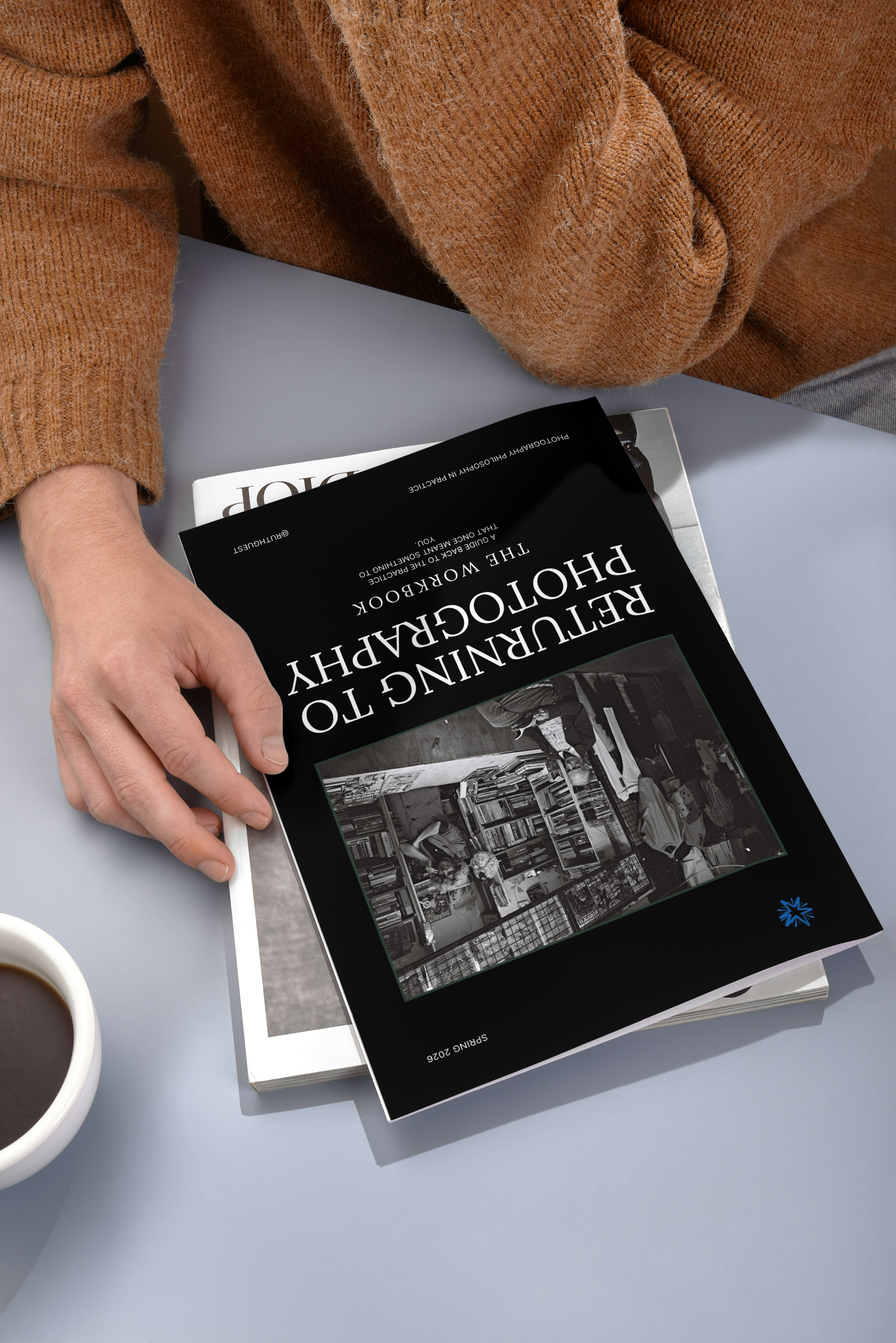
Returning To Photography, The Workbook
A guide back to the practice that once meant something to you.
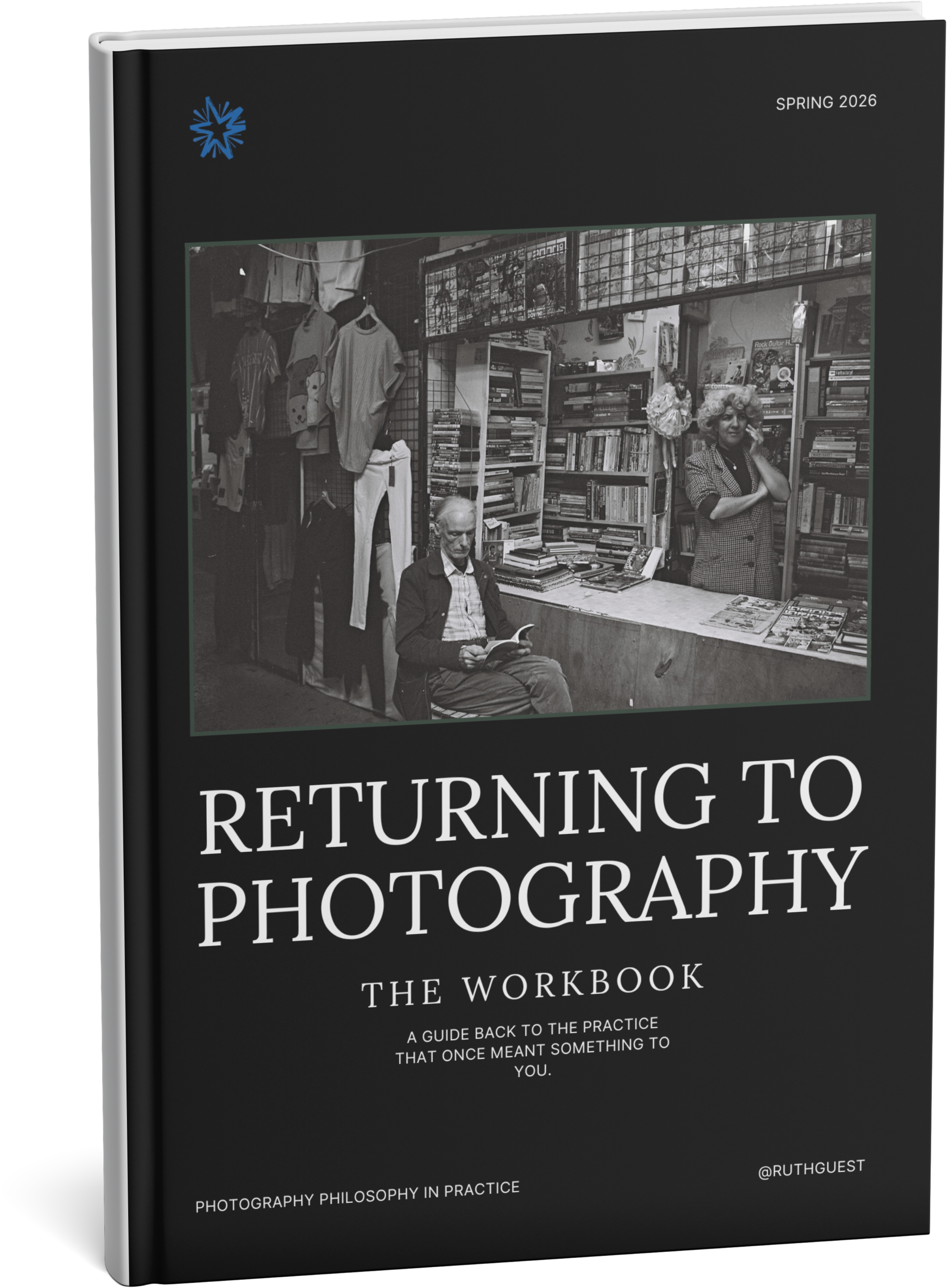
The Mass Drift.
We're living in the Society of the Endless Image. Photographs everywhere you look. Other people's work, other people's lives, other people's images and reels filling your feed every single day. The algorithm has become your creative director, and you never hired it.
I was so sick of it, too. Sick of the screens and the digital noise. Sick of pretending to be something I wasn’t. My photography showed that I’d drifted from myself, my work, and why I picked up the camera in the first place. But I realised my voice didn’t actually disappear, it just got buried under everyone else’s. This workbook was how I found my way back.
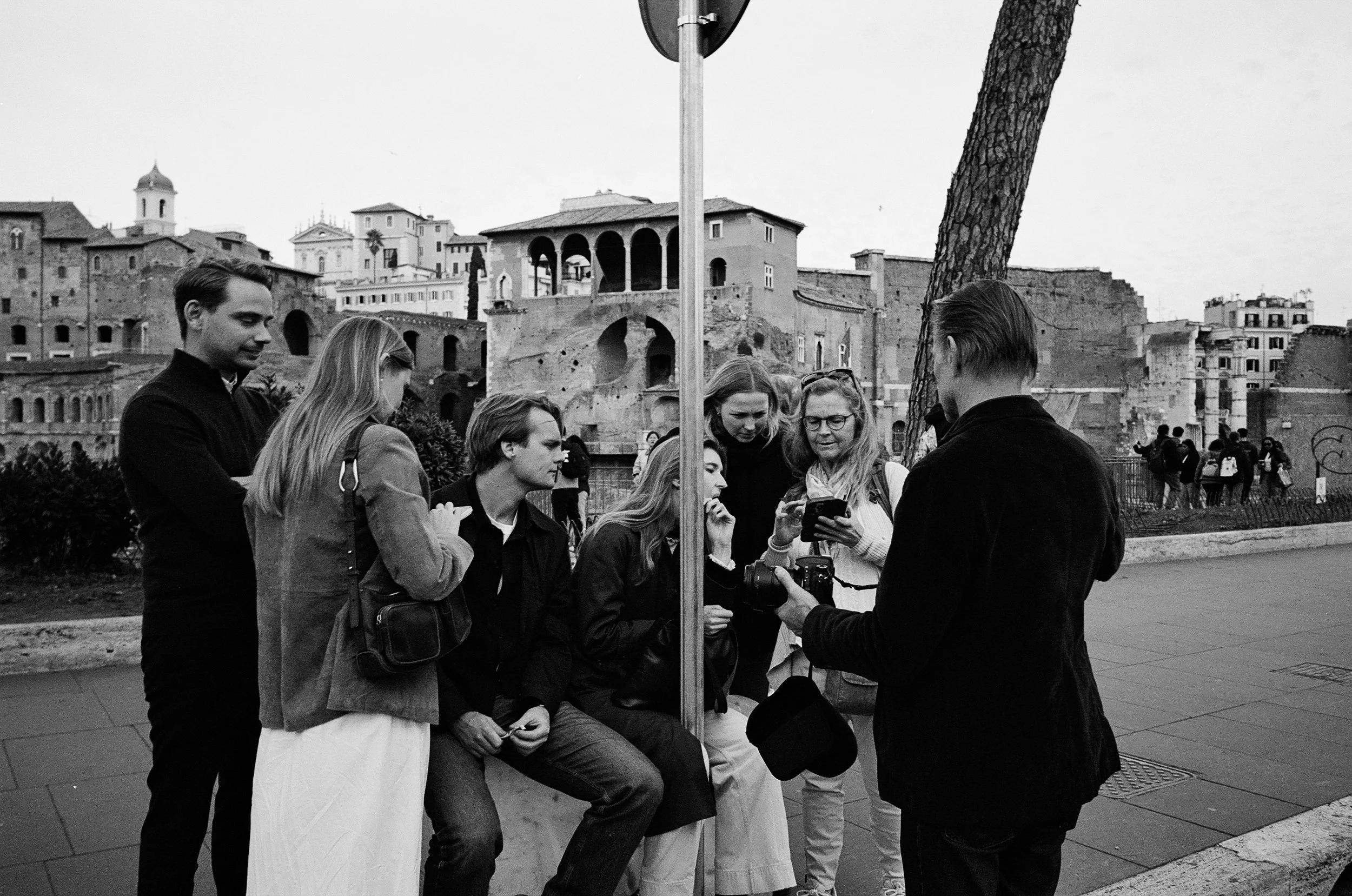
Returning to Photography, The Workbook
10 original frameworks.
22 exercises.
18 reflection questions.
100+ pages.
Most photography advice asks: “how do I get better?”
Wrong question.
The right question should be: “why did I stop?”
I believe photographers and artists need to dive into the why, and everything else follows. What follows is learning how to build a practice, develop your style, and your legacy. This workbook will help you finally understand your blockers, your desires, and why you pick up the camera in the first place.
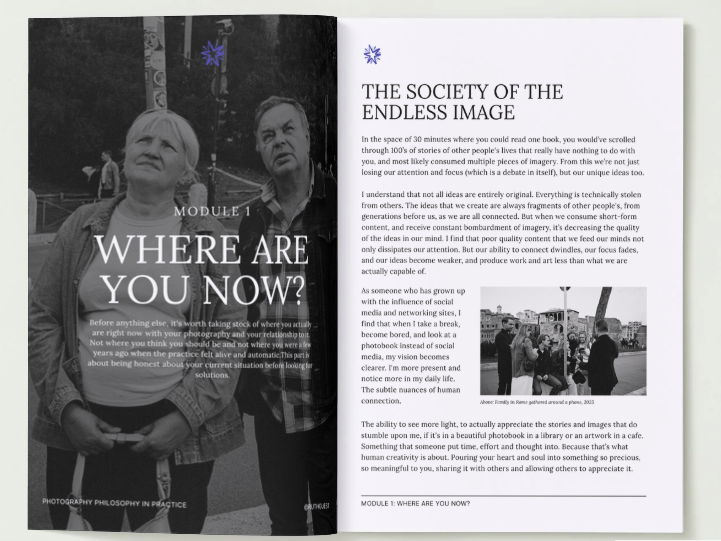
Module 1 — Where you are now
Before anything else, you need to be honest about where you actually are. Not where you think you should be. Not where you were three years ago when picking up the camera felt automatic.
We're living in the Society of the Endless Image. Photographs and videos are everywhere. Ads, Instagram, other people's lives on a black mirror in your pocket, fighting for your attention every moment of the day. Your eye has been so saturated with other people's vision that your own has basically disappeared. This is what I call the Mass Drift. And it happens to almost every photographer at some point.
This module names what happened, and once you can name it, you can start to move.
Includes the Media Fast Exercise and questions designed to pinpoint exactly when you stopped noticing.
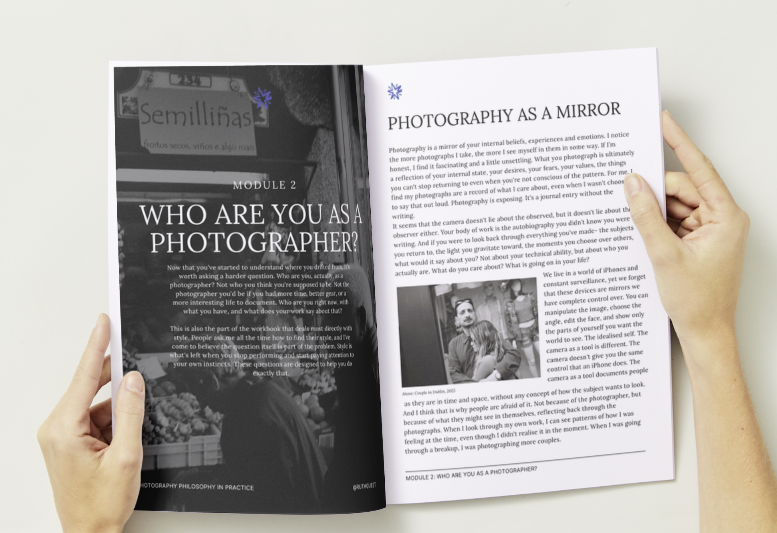
Module 2 — Who you are as a photographer
Here's something I only understood recently. The subjects you keep returning to, the light you're drawn to, the moments you choose over others, I don’t believe they’re random. I believe your work is a mirror of your internal state. What you photograph is a reflection of your desires, your fears, your values. The things you're not even conscious of choosing.
When I was going through a breakup, I was photographing couples. When my brother left for Australia, I was shooting themes of friendship and coming of age. But the funny thing is, I didn't realise it until I looked back. Your camera has been telling you something this whole time. This module helps you hear it.
Includes the Archive Audit, the Emotion Audit, and the Camera as Armour exercise, probably the most uncomfortable and most useful thing in this workbook.
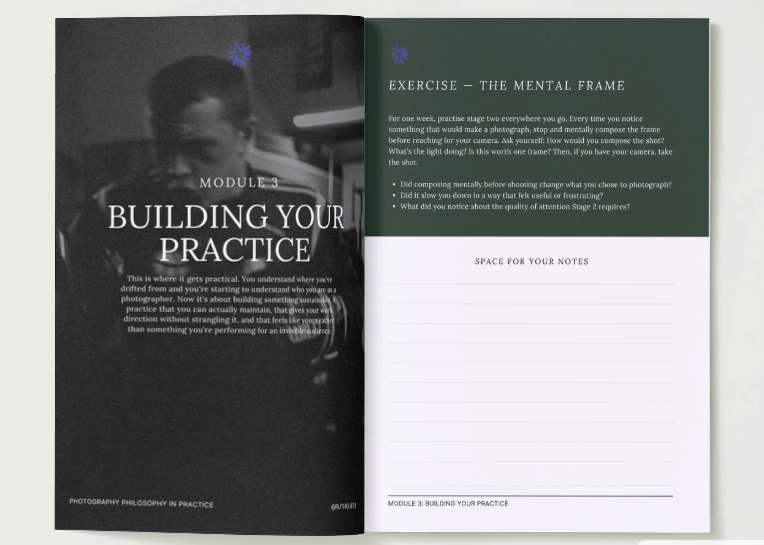
Module 3 — Building your practice
Most photographers try to fix their practice by adding more. A new camera, subject or location. But it never works because the problem was never what you own or where you visit; it’s how you were approaching your craft in the first place.
The Contained Practice changed everything for me. One camera. One lens. One film stock. I found that when I removed the endless decisions, I was left with the only thing that ever mattered: my eye. Incorporating this with the Three Stages of Seeing will permanently change how you look at the world, with or without a camera in your hand.
Includes Design Your Contained Practice, the One Slow Walk, Shooting Blind, the 3-30 Rule and the Mental Frame exercise.
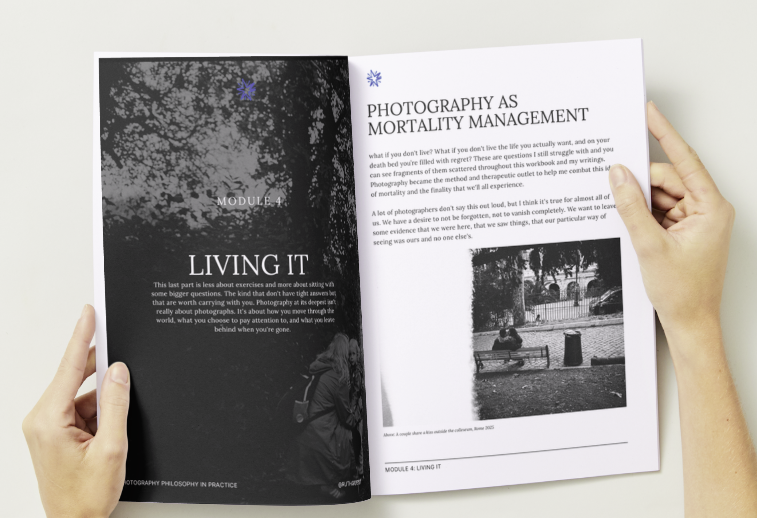
Module 4 — Living it
This is the module people don't expect. And the one that stays with them longest. Why do you actually take photographs? I personally think most photographers are trying to escape death, to leave proof that they were here, that they saw things, that their way of seeing was theirs and no one else's. I know that's why I do it. And when you understand your real reason about why you pick up the camera, the mass drift loses its grip. The practice becomes something you return to effortlessly and it’s not something you have to force.
Includes Document One Week, Write Your Photography Philosophy, and questions about what your body of work actually says about who you are.
I'm Ruth Guest.
Photographer and Cyberpsychologist based in Dublin.
I spent years shooting fashion and portraits across Europe and feeling nothing. I built a tech startup that failed. Recently left a toxic job. And last year, I sold all my digital gear and bought a secondhand Leica from 1983 on eBay with no light meter and no backup.
Not because it was the smart thing to do. Because I was done waiting to live the life I actually wanted.
I built these frameworks because I needed them at the time. I couldn't find anything that addressed why photographers fall out of love with shooting. Not technically, but psychologically. So I wrote it myself.
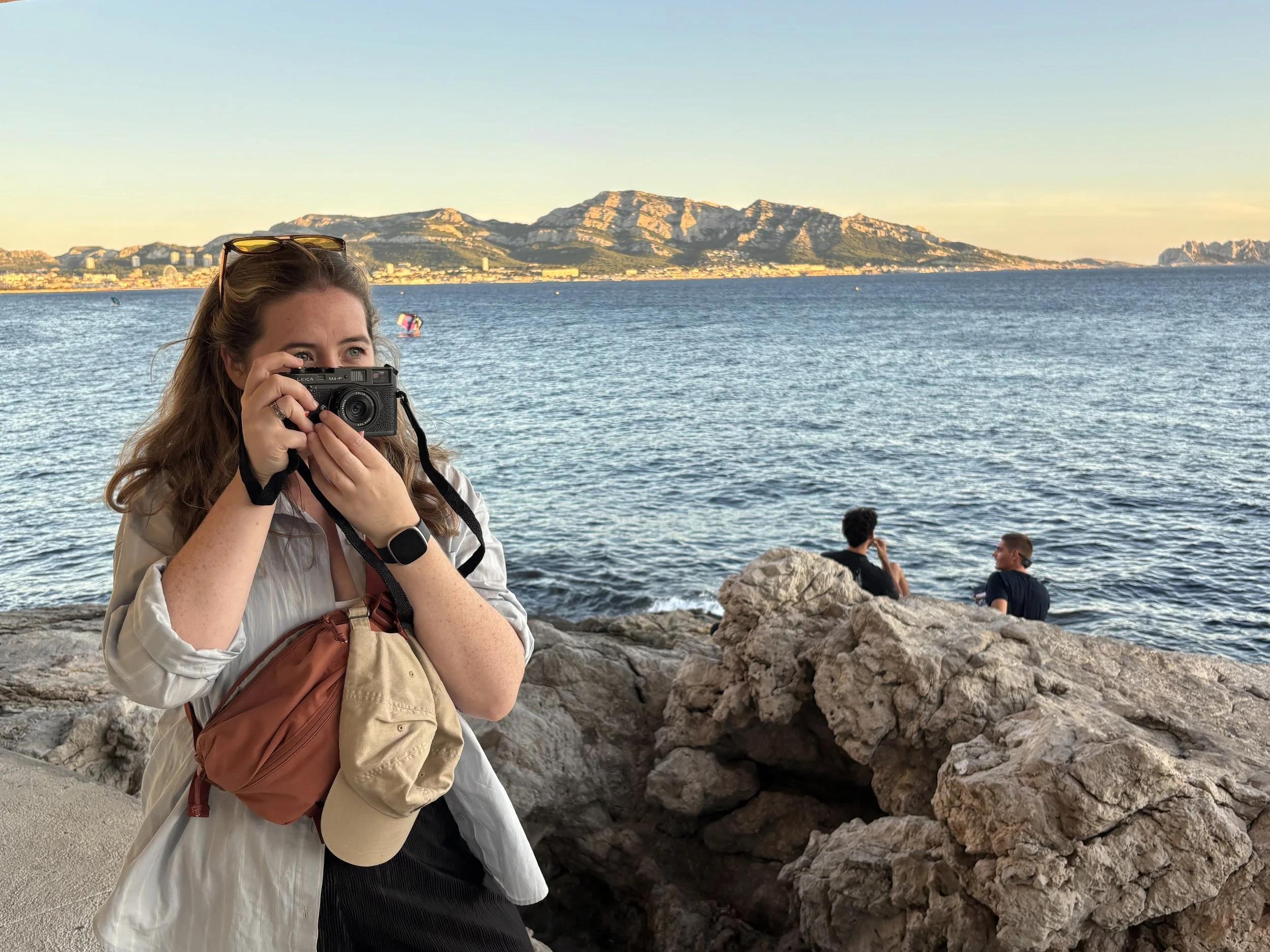
I hold a first class MSc in Cyberpsychology; the study of how technology shapes our behaviour, identity and self-concept. I think about this constantly in relation to photography and other forms of creativity. I don’t believe the algorithm is neutral, it's been reshaping what you think your work (and life) should look like. This workbook is the antidote.
This workbook is for you if:
✅ You've been shooting for years but the work has stopped feeling like yours.
✅ You’re interested in the society and how it affects our vision and the photos we take.
✅ You know your camera inside out but something is missing and you can't name it.
✅ You're tired of photography content that talks about gear and ignores everything that actually matters.
✅ You want to reconnect with photography as a practice, not a performance.
✅ You want to shoot from an honest place again. Not for the algorithm, not for validation, but because it means something to you.
This workbook is NOT for you if:
❌ You're a beginner looking for technical instruction.
❌ You want a quick fix.
❌ You're happy with your current practice.
❌ This is not a motivation boost and it's not a shortcut. It's a serious companion for photographers who are ready to ask themselves the harder questions.
10 original frameworks.
22 exercises.
18 reflection questions.
100+ pages.
(and plenty of space for note-taking too)
Less than three rolls of film, development and a scan. Less than one hour with a photography tutor. Less than the last lens you bought that didn't fix anything.
The Returning To Photography is a digital download, ready for you to print out and scribble in to your heart’s content. Your love of photography is still there. It's been there the whole time. You didn't lose it, you just need to find your way back. This is how. Download it, print it out, pour some coffee and enjoy.